Showing posts with label OWS. Show all posts

Friday, April 12, 2013

OWS Library Wins Lawsuit Against NYC

In the early-morning hours of November 15, 2011, the New York Police Department (NYPD) and city sanitation workers swept into Zuccotti Park, renamed "Liberty Park" by the mixture of people who had settled there two months earlier to protest income disparity, financial industry corruption, the high costs of education and healthcare, and more. In the process of removing the protestors from the park - with the approval and complicity of Brookfield Properties, owner of the park - the NYPD destroyed hundreds of thousands of dollars worth of property, including books and equipment from the People's Library.

A young woman and older man (in the background) browse the People's Library.
Image via http://booklolly.files.wordpress.com


The People's Library, established in the northeast corner of Liberty Park, consisted of shelving and crates containing more than 5,000 books, a few of which I donated as a supporter of Occupy Wall Street. In that same corner of the park, tables were set up for library users and computers with WiFi connection were made available to any patron who wanted to use them. The People's Library was a grassroots effort - created, organized, and managed by a dedicated group of actual librarians, information professionals, and book-loving volunteers who valued the democratization of information. When I visited, the People's Library was a bustling hub of people from all backgrounds flipping through, reading, and donating books.

In the November 2011 raid, the NYPD tossed thousands of these books into trash-compactor trucks, then hauled them to a storage facility, where OWS library workers were later told that they could retrieve them. Arriving at the storage facility, the library workers were alarmed to find that only 1,000 of the books were salvageable and the rest were damaged beyond repair: smashed, wet and moldy, and covered with food and waste. Occupy Wall Street decided to sue the City of New York for damages, asking for $47,000 in compensation to be paid to the movement's Library Working Group. The famous civil liberties lawyer Norman Siegel took their case and the suit was filed in February 2012.

On Tuesday, April 9, 2013, OWS won their case against New York City. Rather than going to trial, the City of New York and Brookfield Properties agreed to settle, paying more than $230,000 in damages and legal fees. OWS got the $47,000 it sought for damage to the People's Library.

"Our clients are pleased," Siegel told the Village Voice. "We had asked for damages of $47,000 for the books and the computers, and we got $47,000. More important - we could not have settled without this - is the language in the settlement. This was just not about the money, it was about constitutional rights and the destruction of books."

Thursday, August 30, 2012

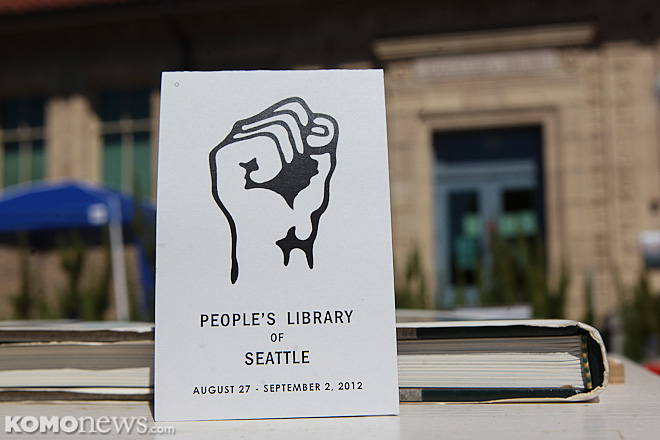
OWS' People's Library Serves Seattle Amid Closures

Now through September 2, the entire Seattle Public Library system is closed due to budget cuts. What are students, parents, those without home Internet access, and others in the community supposed to do? Thankfully, Occupy Wall Street activists have stepped up to fill the void during this furlough period. They've opened the People's Library on the steps of the Douglass-Truth branch at 23rd and Yesler, and people of all ages and backgrounds are flocking to it.


Organized in 10 days' time, thanks to word-of-mouth and social networking, the Seattle People's Library consists of donated books shelved in neatly stacked milk crates and wooden boxes, borrowed laptops with WiFi connections arranged on folding tables, a space set aside for recycling, and an area for the preparation and serving of food. The People's Library even has a daily schedule of events, which include storytime and crafts for children, live musical performances, and meals (snacktime, lunch, and dinner). Anyone can drop by to make use of the library, and anyone can stop by to volunteer or donate books and other supplies.

A girl browses the People's Library of Seattle, organized by Occupy Wall Street activists.
Image from http://bookpatrol.tumblr.com
"I just think it's wonderful," said Laura Sindell, who donated some of her books to the makeshift library. "I want to support them any way I can." An organizer of the People's Library, Charles Conatzer, had this to say: "Literacy is important, and when you have austerity measures that threaten the ability for people to come together and use computers and to get books, it's really not good for the community." Indeed the closure of Seattle's public libraries through Labor Day displeased many patrons. "It's a little bit annoying," said Kristen Fitzpatrick. "My son had picked out some books and they are on hold, so I have to wait another week and I've got a pile of them I'm returning."

But Fitzpatrick looked around at the People's Library and said, "It's great. It's awesome. I didn't know they were going to do that."

The Seattle People's Library is open daily, from 10 AM to 8 PM. If you wish to donate money or food, or if you want to volunteer, you can reach organizers of the People's Library at duetobudgetcuts@gmail.com. You can check out the library's Facebook page HERE.

The quotes in this blog post were taken from the Central District News article "The People's Library Creates Community Library Outside the Closed Douglass-Truth Branch" and the KOMOnews.com article "People's Library Fills in or Seattle Public Libraries During Closure."

Thursday, August 2, 2012

OWS's Tactical and Symbolic Use of Books

Books have long been central to protest movements. Occupy Wall Street is no exception. In addition to its extremely resilient People's Library, OWS has found another effective way to incorporate books into acts of resistance: the book bloc.

Book blocs at an Occupy Wall Street protest in Oakland, California.
Photo via http://reclaimuc.blogspot.com
What are book blocs? They are shields that have been decorated to resemble books, particularly titles that have strongly political or revolutionary themes, such as The Wretched of the Earth, by Frantz Fanon; Assata: An Autobiography, by Assata Shakur; and Letters of Insurgents, by Fredy Perlman. Protestors hold these shields in front of them as they march. By doing so, they not only have some protection against flying police batons, but they also produce an incredibly striking image for the highly visual media. Book blocs were first seen in Italy in 2010. Since then, they have appeared in grassroots actions in Spain, London, New York, California, and elsewhere. On Governor's Island, OWS in New York recently held a workshop on making book blocs. It looks as if the book bloc will continue to be a regular visual component of OWS protests worldwide.

For a bit more on book blocs, and how OWS is using them, go HERE and HERE.

Saturday, May 26, 2012

OWS Sues Over Destruction of People's Library

When the New York Police Department swooped into Zuccotti Park on November 15, 2011, they destroyed a great deal of property that had been carefully collected and assembled by Occupy Wall Street. Among this property was the People's Library, set up at the northeastern corner of the park and consisting of thousands of donated titles. Many of these titles were rendered completely useless due to the rough handling of the NYPD during the early-morning raid.

Books from the People's Library were destroyed during the NYPD's raid of Zuccotti Park last fall. (Photo credit: http://peopleslibrary.wordpress.com/#)

Now, in addition to encouraging the building of digital People's Libraries and setting up on a smaller scale in Union Square Park, organizers of the OWS library are suing Mayor Michael Bloomberg and others over the destruction of their property last fall. According to a Village Voice article, which I've reblogged below, OWS is seeking $47,000 in compensatory damages and $1,000 in punitive damages. More than 2,000 books were confiscated and subsequently lost or damaged, and six library computers, a wireless Internet device, and shelving attached to the library were also destroyed. Norman Siegel, the attorney representing OWS, said, "Anyone in the Bloomberg administration, including the mayor, who thought they could get away with this, well, it's six months later and we're now in Federal Court."


Village Voice * May 24, 2012

Occupy Wall Street Sues Bloomberg and New York City Over Library Destruction

Six months after the New York Police Department launched a secretive dead-of-night military-style operation to evict Occupy Wall Street protesters from Zuccotti Park, conducting mass arrests and destroying thousands of dollars worth of property, Mayor Bloomberg, Police Chief Ray Kelly, and others are being sued in federal court.
In a complaint filed today in US District Court, Occupy Wall Street is suing for compensatory and punitive damages and seeking a declaration that the city and its agents violated the constitutional rights of the movement's members.

The lawsuit is specifically pegged to the destruction of the Occupy Wall Street People's Library, at the time a collection of some 5,500 donated volumes that had served as a powerful symbol of the movement's commitment to critical inquiry and self-sufficiency.

On November 15, the night of the raid, about 3,600 of those volumes were on site at Zuccotti Park. Around 1 a.m. that night, the NYPD swarmed the park, surrounding it and announcing that everyone had to leave and take any property with them. Librarians attempted to move the collection, but after removing their first load were barred reentry into the park. 45 minutes later, police and sanitation crews began throwing property still in the park -- including library books -- in trash-compactor trucks. The majority of the library was completely destroyed.
Eventually, librarians were able to recover 1,003 volumes from the city's storage facility. But more than 200 of those were so damaged -- smashed, accordioned, soaked and moldy, smeared with food and waste -- that they were effectively destroyed.
Also wrecked were six library computers, a wireless internet device, and shelving attached to the library. All told, $47,000 worth of property was destroyed.
The sacking of the library has become a rallying point for Occupy Wall Street, which sees the destruction as a metaphor for what they see as the city's efforts to stifle the exchange of critical ideas that took place in the occupied park.
Occupiers and their lawyers also recognize the public-relations opportunity presented by the city's wanton destruction of books. Attorney Norman Siegel invoked Nazi Germany and the Florida Koran-burning, concluding "The bottom line is: You don't nuke books."
The lawsuit asks for $47,000 in compensatory damages, as well as punitive damages. But in recognition that sanitation employees, who the city doesn't indemnify against punitive damages, might get stuck with the bill, Occupy Wall Street took the unusual step of limiting its request for punitive damages to $1,000.
Also significant is the insight into the planning process behind the November 15 raid that the case may produce. If it goes forward, the discovery process is likely to illuminate aspects of the city's decision-making process that have so far remained opaque.
The main point, said Siegel, is to get some acknowledgment that the raid was unconstitutional, violating protesters' First-Amendment rights to freedom of speech, their Fourth-Amendment rights against unreasonable search and seizure, and their Fourteenth-Amendment rights of due process.
"Anyone in the Bloomberg administration, including the mayor, who thought they could get away with this, well, it's six months later and we're now in Federal Court," Siegel said.
Siegel noted that other cities that ultimately evicted Occupy encampments went to court first before moving in with police. In New York, there was no pre-hearing before the surprise night-raid.
City lawyers initially tried to amicably resolve the issue, Siegel said, but that after conferring with the administration they told the plaintiffs there could be no settlement.
"My sense was the Bloomberg administration was not prepared to say it did anything wrong," Siegel said. "Look, if we can amicably resolve this without going to court, great. But we want a declaration for historical purposes, that the government can't do what it did on November 15 and get away with it."
One of the Occupy Wall Street librarians, Frances Mercanti-Anthony, echoed the sentiment: "Mayor Bloomberg and the NYPD and the City of New York think they can shut down this conversation, and they can't," she said. "We're just going to keep coming."
Here's the complaint filed today:

Thursday, March 29, 2012

OWS Library Confiscated Yet Again by NYPD

Anyone who's walked through Union Square lately has seen the OWS set-up at the south end of the park.

Occupy Wall Street sets up in New York City's Union Square, March 2012.
image source: adam ebihara photography

Although not nearly as big (or as structured) as last year's encampment at Zuccotti Park, Occupy Wall Street's presence in Union Square is still noticeable. It has definitely got the attention of law enforcement. Last week, the local authorities moved in to confiscate the latest reincarnation of OWS's library. Jason Boog covered the police action for GalleyCat (see below).


GalleyCat * March 22, 2012

Occupy Wall Street Library Confiscated in Union Square

By Jason Boog

Earlier this week, the Occupy Wall Street librarians posted a picture of the newly rebuilt Occupy Wall Street Library in New York City's Union Square Park. By the end of the day, police had cleared out most of the library - leaving behind the books in the picture (embedded above).

Below, we've created a chronological collection of tweets from the activists showing what happened to the library. The librarians tweeted a new chant today: "People got sold out, books got thrown out!"

Storified by
8 days ago · 1024 views
  • 4
  • 4

Occupy Wall Street Library in Union Square

Last night the Occupy Wall Street Library was rebuilt in Union Square, but it was soon cleared away by police officers.
Once again the #NYPD has destroyed The People's Library. Here is what is left from last night #UnionSq http://pic.twitter.com/EAYDfLYI

  1. Got to #UnionSq to find one of our @OWSLibrary peeps arrested & the books, bins & supplies we brought yesterday taken by the #NYPD

Thursday, February 9, 2012

Archiving the Occupy Wall Street Movement

On the subway yesterday, I noticed that a woman standing near me was prominently wearing an "Occupy" button. "Occupy" buttons, T-shirts, fliers, signs, posters, and other emblems of the Occupy Wall Street (OWS) movement are becoming highly sought-after items for a growing number of people and institutions.

A woman at Zuccotti Park in downtown Manhattan, October 2011.
photograph taken by the author of this blog

Many institutions - among them, libraries, museums, and historical societies - are actively archiving materials from the grassroots movement. One of these institutions is Queens College's Rosenthal Library, which has been gathering materials for its OWS archive since last November. It is also amassing the oral histories of occupiers. For more details on what Rosenthal Library is doing to preserve OWS history, see the Knight News article below.


The Knight News * January 29, 2012

Preserving OWS History

Part of the Queens College Rosenthal Library's Occupy Wall Street archive.
Photo: Monica Palermo

By Monica Palermo

The Queens College Rosenthal Library has started an archive of the Occupy Wall Street (OWS) movement, which began in September 2011 in Zuccotti Park and quickly spread into a world-wide phenomenon.

Faculty from the QC libraries department of special collections and archives traveled to Zuccotti Park to collect artifacts and oral histories in November 2011 in an attempt to preserve the movement.

“[Occupy] Wall Street is the first defining movement of the 21st century,” said Ben Alexander, head of the special collections and archives at QC.

Alexander, who came up with the idea for the OWS archive at QC, went down to the movement with two other members of the department.

The archive is comprised of many different materials, such as flyers, including ones from Occupy Queens College, posters with slogans such as “Health care is a human right,” minutes from meetings, buttons and a T-shirt.

The most important pieces in the collection are the oral histories, which document the movement through interviews with occupiers, according to Alexander.

“The people were extremely friendly and knowledgeable,” said Annie Tummino, who manages the library’s civil rights archive and who went to OWS with Alexander. “They provided great background on why they were there and what they had done.”

This OWS archive is just one of many. According to an article from The Brooklyn Ink, a news outlet staffed entirely of students at the Columbia University Graduate School of Journalism, called “The Anarchivists: Who Owns the Occupy Wall Street Narrative?,” not only is there a OWS archive owned by the movement itself that acts as a leaderless archive, but there are also archives starting up at large institutions such as the New York Historical Society, New York University’s Tamiment Library and the Smithsonian’s Natural Museum of American History, who are looking to become the defining archive of OWS History.

“You have big established institutions in New York, kind of fighting to get control of whatever the archive is,” said Alexander, who finds the power struggle ironic. “Some of these institutions are decidedly the one percent negotiating with the movement to become its archive, and it seems to me very out of touch with the ideas that are at the center of the movement.”

Compiling an archive for OWS is tricky because Occupy is an idea, according to Alexander. Another reason why it can be difficult is because archiving information has changed with “people being rushed to create a historical record within days of it happening.”

Archives are typically formed years after history has been made. Twenty-first century archiving seems to happen as events unfold, which Alexander believes will continue to be the trend.

Although there is no official date planned, Tummino said, that like with any of the other collections in the special collections and archives department, it is possible that the materials from the OWS archive will be exhibited.

The OWS archive at the school will continue to be developed by a small group of graduate students this semester. It is not yet open to students, but it will be by the end of spring.

Tuesday, November 15, 2011

Time to Build a Digital People's Library!

Just a week before today's NYPD raid of Zuccotti Park, the Occupy Wall Street Library urged those beyond the park to start People's Libraries of their own.

The People's Library at Zuccotti Park, NYC.
photo source: http://peopleslibrary.wordpress.com

Jason Boog, of GalleyCat.com, took this proposition one step further by encouraging the creation of People's Libraries in digital form. "What free Ebooks do you want to share with your neighbors?" he asked.

By being online, a People's Library is safe from any physical destruction wrought by the police at Zuccotti Park or at other increasingly endangered OWS encampments across the country.


GalleyCat.com * November 10, 2011

Build a Digital People's Library

By Jason Boog


The Occupy Wall Street People’s Library blog is urging other readers to create People’s Libraries in their neighborhoods.

Check it out: “if you’d like to open a branch of the People’s Library in your New York neighborhood, find a [Privately Owned Public Spaces], bring down some books and meet your neighbors. It all starts with a few books in a box.”

We realize that many GalleyCat readers don’t live in New York City and that winter is coming. But we’d love to see more People’s Libraries around the country–so let’s open a few Digital People’s Libraries. What free eBooks do you want to share with your neighbors?

Explore free eBook collections at eBookNewser, Project Gutenberg or the Internet Archive for ideas.

Post your list on your blog, Facebook page, LibraryThing page, Twitter account, Goodreads page or Tumblr blog. Share the link and your location in the comments section and we’ll build a directory of Digital People’s Libraries around the country.

This GalleyCat editor posted a Digital People’s Library to get you started. (Photo via nic221 on Flickr)

Tuesday, October 11, 2011

OWS Library Catalog Is Online

The Occupy Wall Street Library
photo credit: http://brooklyncollegezines.commons.gc.cuny.edu

The Occupy Wall Street (OWS) protests are still going strong in lower Manhattan, where a group of activists have established a good collection of books amid the commotion. Called the Occupy Wall Street Library, the collection has more than 500 titles so far.

Books range from the political (Keith Olbermann's Pitchforks and Torches; John Burnheim's Is Democracy Possible?) to classic works of fiction (Jane Austen's Sense and Sensibility; Charles Dickens' Oliver Twist). The collection is growing all the time, thanks to donations, which can be sent here:

Occupy Wall Street Library
c/o UPS Store
118A Fulton Street, #205
New York, NY 10038

Since the books and other library materials are on display outdoors, donations of waterproof containers and tarps are also welcome.

If you're curious as to what else makes up the OWS Library but can't make it down to Wall Street, you're in luck! The organizers of the library have set up an online catalog of the collection. The Occupy Wall Street Library's catalog can be viewed HERE.