Showing posts with label New York Public Library. Show all posts

Wednesday, August 13, 2014

Queer Book Dioramas on Display at NY Public Library

In the heart of Greenwich Village, a historically gay-friendly neighborhood in New York City, is a never-before-seen display of creativity...in miniature.
 
Michelle Brennan's diorama of Roving Pack, by Sassafras Lowrey.
Image via http://www.thedailybeast.com

The Queer Book Diorama Show is currently on view at the Jefferson Market Branch of the New York Public Library. The library, located on 6th Avenue, between West 9th and 10th Streets, is housing dioramas that were assembled by thirteen LBGTQ artists. Hailing from the United States, Canada, and South Africa, these artists have chosen to explore the relationship between LGBTQ readers and literature through the construction of their dioramas.

The artists, and books they interpreted as dioramas, are: Melissa Sky and Jennifer Corbett, Beebo Brinker Chronicles by Ann Bannon; Michelle Morgan, Chelsea Girls by Eileen Myles; Michael Moran, Dancer from the Dance by Andrew Holleran; Jenny Lin, Female Masculinity by Jack Halberstam; Jacky Flagg, Fun Home by Allison Bechdel; Jason Bishop and Tim McMath, Mommy Dearest by Christina Crawford; Kate Conroy, Oranges Are Not the Only Fruit and Rubyfruit Jungle by Jeanette Winterson and Rita Mae Brown, respectively; Michelle Brennan, Roving Pack by Sassafras Lowrey; Victoria Baker, Rubyfruit Jungle by Rita Mae Brown; Daniel Roza Lang, Time Considered as a Helix of Semi-Precious Stones by Samuel R. Delany; and Ketch Wehr, The Story of Ferdinand by Munro Leaf.
   
Jason Bishop and Tim McMath's diorama of Mommy Dearest, by Christina Crawford.
Image via http://www.thedailybeast.com 

The Queer Book Diorama Show was curated by writers Sassafras Lowrey and Hugh Ryan. Speaking to the Daily Beast, Ryan said, "Sassafras and I wrote a call inviting people to create a diorama based on a book that was meaningful to them in their development of their queer identity. We received nearly 100 proposals from around the world - including Canada, South Africa, Ireland, and the Czech Republic - for dioramas that ranged from pocket-sized to life-sized, on everything from picture books to dense philosophy. Had we not been limited by the space of the gallery, we would have included all of them!"

In addition to the dioramas, there will be panel discussions with the artists. Melissa Sky, Michelle Moran, Jacky Flagg, Kate Conroy, and others will shed light on their artistic process, as well as converse about queer art and literature and explain the relationship between author and reader. The panel discussions will take place at the Jefferson Market Library and will be free to attend for the general public. Sassafras Lowrey and Hugh Ryan will moderate the discussions, which are scheduled to begin at 7PM on Friday, September 5, and Friday, September 19. For more details on the scheduled events, go to THIS LINK.

The Queer Book Diorama Show was made possible through the sponsorship of the Lambda Literary Foundation, the Pop-Up Museum of Queer History, MIX NYC, and the New York Public Library.

"It has been amazing to see the outpouring of inspiration," Ryan told the Daily Beast, "as well as the crucial institutional support from the Pop-Up Museum of Queer History, the Lambda Literary Foundation, MIX NYC, and the Jefferson Market Branch of the New York Public Library! In our own small way, this show is a gift to the community and an offering to all other queers who, like us, stood before a card catalog or library shelf looking for belonging."

The Queer Book Diorama Show will be at the Jefferson Market Library through September. For more information on the show, see THIS LINK and THIS LINK.

Sunday, March 2, 2014

'A Raisin in the Sun' Exhibit Opens at NYPL

Fifty-five years ago this month, Lorraine Hansberry's A Raisin in the Sun opened on Broadway. Premiering on March 11, 1959, at the Ethel Barrymore Theater, it was the first play by a black woman playwright produced on the "Great White Way." 

A Raisin in the Sun playwright Lorraine Hansberry in 1959.
Image via ralphmag.org

A Raisin in the Sun was also the first play in the history of Broadway to have a black director, Lloyd Richards. Its nearly all-black cast featured Sidney Poitier, Ruby Dee, Claudia McNeil, Louis Gossett Jr., Diana Sands, Ivan Dixon, Glynn Turman, and John Fielder, among others. The show was a huge success. A Raisin in the Sun ran for 530 performances, and the production earned numerous accolades, including the New York Drama Critics' Circle Award for Best Play.

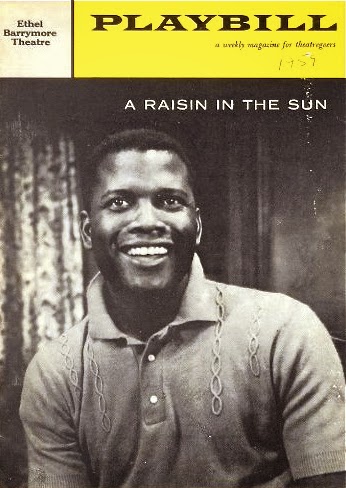
The original Broadway playbill from 1959.
Image via Amazon.com

On the eve of the play's 55th anniversary, the New York Public Library has opened an exhibit that showcases original items from the 1959 Broadway production. The exhibit, titled "A Raisin in the Sun: Lorraine Hansberry's Dream on Broadway," can be seen in the McGraw Rotunda on the third floor of the Stephen A. Schwarzman Building on 42nd Street and Fifth Avenue. Items in the New York Public Library's commemorative exhibit include:

  • The original Broadway playbill with Sidney Poitier on the cover
  • The original manuscript of A Raisin in the Sun, with production notes
  • Letters of congratulations from Langston Hughes, Tennessee Williams, Ossie Davis, and others
  • A 35-minute documentary from 1970 on Hansberry running on a loop
  • Photographs from the original cast rehearsal of the groundbreaking play

"A Raisin in the Sun: Lorraine Hansberry's Dream on Broadway" is on display at the New York Public Library now through March 16. Viewing hours are 10 AM to 8 PM on Tuesdays and Wednesdays, 10 AM to 6 PM on Mondays, Thursdays, Fridays, and Saturdays, and 1 PM to 5 PM on Sundays. If you're in New York between now and March 16, be sure to check it out.

For more information on NYPL's "A Raisin in the Sun" exhibit, go HERE and HERE.

Friday, January 10, 2014

Books That Have Changed the Course of History

I was once serious about learning how to consult the I Ching. I had read a few memoirs written by members of the 1960s counterculture in which they talked about turning to the I Ching before making any serious decisions...or at least before leaving the house. So I figured I would try to unlock this ancient book's wisdom, even going as far as concurrently buying the I Ching for Beginners by Brandon Yusuf Toropov to help me along the way.
 
Image via the interwebs

After a while, however, the I Ching, the I Ching for Beginners, and three pennies began to gather dust on my bedside table. A few years later, I gave both books to a friend who had expressed interest in them. Still, I understood and respected the influence of this "Book of Changes," which has guided countless many throughout the centuries. "The importance of I Ching is phenomenal," stated Megan Willett, in an article for Business Insider. "Not only do Confucianism and Taoism have common roots here, but people around the world still use it for divination and fortune telling purposes to this day." For this reason, the I Ching has been recognized as one of the "25 Books That Have Changed the Course of History," according to Willett, who worked with Miriam Tuliao, assistant director of central collection at the New York Public Library, in compiling the list.

Among the "25 Books That Have Changed the Course of History," I was not surprised to see The Jungle by Upton Sinclair ("It galvanized public opinion and led to a forced government investigation that eventually caused the passage of pure food law"); Silent Spring by Rachel Carson ("The book is widely credited with helping launch the contemporary American environmental movement, spurring revolutionary changes in laws affecting our air, land, and water"); How the Other Half Lives by Jacob Riis ("Riis made it his mission to show the upper and middle class the dangerous conditions the poor faced every day with graphic descriptions, sketches, statistics, and his photographs"); and The Feminine Mystique by Betty Friedan ("The book helped spark second-wave feminism by encouraging women to look beyond marriage and motherhood for their fulfillment, and challenging traditional patriarchal expectations").

Other books on the list are On the Origin of Species by Charles Darwin ("Not only was On the Origin of Species the foundation of evolutionary biology, but the concept of evolution and natural selection continues to have a major impact on modern scientific theories, politics, and religious discourse, particularly in the United States"); The Communist Manifesto by Karl Marx ("the manifesto resonated with industrial workers across Europe, the U.S., and Russia with its rallying cry: 'Working men of all countries, unite!'"); and Narrative of the Life of Frederick Douglass by Frederick Douglass ("The book was fundamentally influential on the American abolitionist movement, as well as politics in the U.K. and Ireland, where Douglass later spoke publicly about his narrative"). Also on the list is Tao Te Ching by Lao Tzu (a "philosophical text about living life simplistically and working for the greater good"), which I want to read because of my interest in Taoism.

To see all "25 Books That Have Changed the Course of History," go to THIS LINK.

Tuesday, October 29, 2013

Poe at the Morgan Library & Museum

In time for Halloween, the Morgan Library & Museum in New York is hosting an exhibit on a writer whose classic works still give modern-day readers the willies. 

An image of Poe on display at the Morgan Library & Museum.
From http://www.themorgan.org

Aptly titled "Edgar Allan Poe: Terror of the Soul," the exhibit features a plethora of items, including handwritten letters, poem and short story manuscripts, early printed editions, literary criticism printed in contemporary publications, daguerreotypes and other images of Poe, and even a fragment of Poe's original coffin. How's that for spooky?

Among the literary works on display are "Annabel Lee and The Bell in his own hand; one of the earliest printings of The Raven; the first printing of The Cask of Amontillado; and an unprecedented three copies of Tamerlane, Poe's earliest published work and one of the rarest books in American literature," according to the Morgan Library & Museum.

Also on view, says the Morgan on its website, are "lesser-known writings, including A Reviewer Reviewed - Poe's never-before-exhibited critique of his own work, written under a pseudonym - and the author's annotated copy of his last published book, Eureka, [that] provide a more complete picture of this complex writer."

There are nearly 100 items to see, all from the Morgan's holdings and the Henry W. and Albert A. Berg Collection of English and American Literature at the New York Public Library. They will be on display through January 26, 2014, so even if you aren't in New York for Halloween, you'll still have a chance to check them out. Any hardcore fan of Poe would be seriously remiss if he or she didn't do so.

For more on the "Edgar Allan Poe: Terror of the Soul" exhibit at the Morgan Library & Museum, go to THIS LINK and THIS LINK as well.

Monday, September 2, 2013

Librarians Win the Internet with 'Sabotage' Remake

I love 1970s crime dramas: the sartorial splendor of the cops' street clothes and hairstyles, the often over-the-top scenarios, the requisite car chase with vehicles flying over hills in the road, and the wah-wah/chicka-chicka of the soundtrack. Most of these elements were incorporated into the Beastie Boys' 1994 video for "Sabotage," making it one of my all-time favorite music videos.

Better book it! This librarian means business: A scene from the "Sabotage" remake.
Image via Huffington Post

Nearly 20 years later, librarians at a Chicago private school are featured in a shot-by-shot remake of the Beastie Boys' hilarious send-up of '70s cop shows, and the video has become a viral sensation. Originally filmed for the annual variety show at the Francis W. Parker K-12 School this past May, the video began to take on a life of its own after it was picked up last month by the New York Public Library for its Tumblr. Then it was shared by the technology and culture blog Boing Boing, and within days the Huffington Post, CBS News, and Rolling Stone spotlighted the Chicago librarians' smart redo.

"I'm blown away by the whole thing," said Mike Ferbrache to RedEyeChicago.com. "It's been amazing to watch." Thirty-eight-year-old Ferbrache, a third-grade teacher at the school, and thirty-four-year-old Duane Freeman, a counselor at the school, made the video with the participation of some very game librarians at Francis W. Parker. Initially, it "was just a fun way to showcase the school's librarians in a new light," reported RedEyeChicago.com. But the video has since racked up more than 500,000 views on Vimeo and over 200 "likes."

The librarians in the video - Anne Duncan as "Story Time," Stephanie McMurray as "Late Fee," Branka Steinbaugh as "Bookworm," and Margaret Threet as "Dewey" - are amazed at all of the attention. "One of them emailed me back and just said, 'OMG,'" Freeman told RedEyeChicago.com.

Looking at the video, it's obvious these librarians "didn't hold anything back. They were 100 percent committed to their roles," said Freeman. To see for yourself, click on THIS LINK to see "Late Fee," "Story Time," and the rest in action.

Thursday, August 29, 2013

Oh, Snap! Take a Pic-Cha at NYPL

One weekend, I went to see a friend's band perform at a local venue. Not far from where I stood was a photo booth. During the show, a giggly couple stumbled into the booth, the bright flash of its camera intermittently illuminating the darkness. 
 

At that moment, it occurred to me that I've never actually had my photo taken in a photo booth. A visit to the New York Public Library would remedy that.
 

Earlier this month, two branches of the New York Public Library installed photo booths on the premises. Visitors to the Stephen A. Schwarzman Building (the famous branch with the two stone lions at the entrance) and the Mid-Manhattan Library (just across the street, at 455 Fifth Avenue) can take their photos at these booths. The booths are proving to be quite popular!
 

Since their installation, these photo booths have produced approximately 2,000 photographs of people who have visited these library branches, according to Denise Canniff, who is director of engagement at the New York Public Library.


Stepping inside the booths, patrons can choose from eight preselected options that explain what brought them to the New York Public Library: Borrowing, Exploring, Learning, Reading, Researching, Studying, Visiting, or Writing. They then have the option of stating where they are from - for instance, any of the five boroughs of New York City or from outside the New York region.
 

The New York Public Library gets data revealing who patronizes the library. Patrons get a funny keepsake of their trip to one of the city's esteemed institutions. All of the photographs are sent to the patrons' email address, and they can be shared via Instagram by using the #NYPL and #NYPLPhotobooth hashtags. The New York Public Library also highlights submitted photo booth photos on its Inside NYPL blog channel and on Facebook and Twitter.
 

I began browsing these photos on the NYPL Photo Booth on Flickr, with the intent of only looking at a few. But I quickly became captivated by the breadth of humanity that passed through the library and by the silly faces that were made, the obvious comradeship between those who took group photos, and the facial expressions (or lack of expression) of those who took photos alone. It's actually a fascinating look at human nature! To take a look for yourself, go to THIS LINK. And if you're ever in New York, stop by one of these two branches of the New York Public Library and take a picture why don't you - it'll last longer.

All photos from http://www.flickr.com/photos/nyplphotobooth

Tuesday, June 4, 2013

NYPL Conservators Provide Tips on Book Care

Before I bought my beautiful red bookshelf,* I kept my books stacked high in piles directly in front of a window and right next to a radiator - two things you DON'T want to do if you want your books to stay in excellent condition. 

You DON'T want to store your books like this.
Image via www.taswrites.com

Exposure to direct sunlight and to extreme heat can do damage to your beloved books, so can not storing them upright. When I did, at last, place my books on the bookshelf - where they belonged - I saw that some had already become slightly misshapen due to the way that they were temporarily stored. So there's something to be said for taking the steps to properly care for your personal collection.

In a recent presentation, conservators at the New York Public Library provided tips and tricks on keeping the books in your home library in tip-top shape. Some of the pointers they offered are:

1. DO keep your books in a stable, moderate environment. Try not to store your books in attics (too hot) or basements (too moist). Too much heat or moisture can speed up deterioration or encourage mold growth.

2. DO keep your books away from direct sunlight. Ultraviolet and visible light can speed up the deterioration  of paper and cause fading or discoloration.

3. DO clean your books regularly by dusting with a clean, dry, soft cloth. Simply hold the book closed and wipe the covers and edges. Vacuuming with a soft brush can also safely remove loose dust.

4. DO shelve books upright, and support them with bookends so they don't slump. If you have oversize or large, heavy volumes that don't fit upright on the shelf, store them flat rather than on the spine or edges.

5. DON'T put your bookshelves along exterior walls, where they may experience temperature and humidity changes. Try to place them along interior walls.

For additional do's and don'ts on the proper care of your books (and papers and photographs) from professional conservators, go to this NYPL link HERE.

* It is again time for me to buy a bookshelf - a larger one!

Thursday, April 18, 2013

Extraordinary Women in Library History

A woman made history as the first black supervising librarian in the entire New York Public Library system. She also co-founded a theater company, was a playwright, and hosted dinners that brought together many of the intellectuals and writers active in the Harlem Renaissance. She was even recognized at the 1939 World's Fair. Who was this extraordinary woman? Regina M. Anderson.

Regina M. Anderson, the first black supervising librarian at NYPL.
Image via http://womenoflibraryhistory.tumblr.com

Anderson and other trailblazers are profiled in Women of Library History, a blog created by the Feminist Task Force (FTF). A division of the American Library Association, the FTF started the blog "to remember the contributions of these important women in librarianship." Women such as Lora Lashbrook, the first female librarian at the all-male University of Notre Dame Law School; Jane Van Arsdale, who was the first curator of one of the first rare book collections in a public library in the United States; and the women of the Everett Woman's Book Club, of Everett, Washington, who founded the city's first library in 1898.

Although created for Women's History Month 2013, the Women of Library History blog is still up and running. It's just four pages long, but it contains a wealth of information that will surely benefit anyone writing a paper on women in library history or those who are simply curious about the subject. You can access the Tumblr blog Women of Library History at THIS LINK.

More on the incredible life of librarian Regina M. Anderson is HERE and HERE.

Thursday, March 21, 2013

Forgot Your Book? Underground Library to the Rescue!

If you take the subway, then I'm sure it's happened to you: moments before your train arrives, you realize you have nothing to read during your commute. Sure, you've got your smartphone to distract you, but it's a bummer there's no signal underground. What to do, other than stare blankly into space until your stop? Students from the Miami Ad School have the answer to your first-world problem.

 
For a class project, three students from the Miami Ad School - Max Pilwat, Keri Tan, and Ferdi Rodriguez - came up with the Underground Library. Not to be confused with the Underground New York Public Library, the Underground Library utilizes smartphone technology in a unique approach to reading while in transit. Pilwat, Tan, and Rodriguez decided to use the city of New York and its subway system to demonstrate their Underground Library concept. 


Affixed in an MTA subway car is a poster that says "Swipe for a FREE read." A rider swipes a smartphone across the poster, and data from that poster is transferred to the phone using near-field communication (NFC) technology, which is already in most smartphones. Looking down at the phone, the rider sees that the first 10 pages from one of the books shown in the poster have been downloaded to the phone. Now, the rider has something to read during the rest of the trip.

When the subway rider leaves the train and goes aboveground, the data on the smartphone will direct him or her to the nearest branch of the New York Public Library, where the book that the 10 pages were excerpted from can be checked out. I guess the potential collaboration between the Underground Library and the New York Public Library is what businesspeople call "synergy." Still, I think it's an excellent idea. If it's officially implemented, I think it will be hugely popular.

To read more about the Underground Library, go HERE and HERE.

* Above photos from http://www.dezeen.com

Saturday, March 9, 2013

Memorable Movie Moments Set in Libraries

Libraries have been the backdrop for some of the best scenes in modern cinema. Can you imagine a Harry Potter film without the Hogwarts Library? How about All the President's Men sans that great aerial shot of the floor of the Library of Congress? These two memorable movie moments set in libraries and fourteen more are spotlighted in the BookRiot article "16 Great Library Scenes in Film."

"I really liked your computer trick": Andie is wooed in the school library in Pretty in Pink.

Naturally, there's that unforgettable scene in Breakfast at Tiffany's where Paul (played by George Peppard) loudly professes his love to Holly Golightly (Audrey Hepburn) as they sit hunched in the New York Public Library. (I'm sure others would say that their favorite library scene in Breakfast at Tiffany's is the one that occurs earlier in the movie, when Holly leads Paul to the famous NYPL branch on 5th Avenue and 42nd Street, where they find and sign a copy of Paul's book, to the obvious dismay of the librarian on duty.)

Then there's the suburban high school library in John Hughes' film The Breakfast Club, where five students from five different cliques are sent for a Saturday detention session. Who can forget the now notorious dance scene, where Allison (Ally Sheedy), Claire (Molly Ringwald), John (Judd Nelson), Brian (Anthony Michael Hall), and Andy (Emilio Estevez) stomp and twirl to the song "We Are Not Alone" that's blasted into the library?

My favorite library scene is from another John Hughes film, Pretty in Pink (which, surprisingly, is not even mentioned in the BookRiot article). It's when Andie (Molly Ringwald) is sitting at a row of computer terminals that are situated in the middle of her high school library. While working at the computer, she gets a mysterious message that is NOT from Duckie. Looking at the scene now, it's amusing to see the antiquated computers, but the sentiment of that scene still moves me.


For more great library scenes in movies, including Ghostbusters, The Shawshank Redemption, and Atonement, see BookRiot's article HERE.

Friday, January 4, 2013

Every Building Has a Story: Muhlenberg Library

Whenever I come across a stately building that looks to be a century old or older, I wonder about its past life: who lived there? What was the surrounding area like when it was built? What was its former use? What is it used for now? I imagine there to be countless stories contained within the walls of these old buildings, but only guessing - often futilely - as to what they could be, I continue on my way.

And what could this building be? Photo taken in 1917 by Irving Underhill, courtesy of the Museum of the City of New York.

Identifying the majestic old buildings that still loom over some city streets has become a bit of a game, thanks to Cornerspotter. This regular feature of the real-estate website Curbed asks readers "to identify the location and/or identity of a particular building in a historic photograph." Whoever guesses correctly doesn't win a prize, but they do get bragging rights for being well-versed in their city's history (or at least for being highly observant of their surroundings).

A recent Cornerspotter asked readers to identify the above building, which it said "was built in the early 1900s, and it's still used for the same purpose today." More than a few Curbed readers correctly identified the building as the Muhlenberg branch of the New York Public Library, located at 209 West 23rd Street, between 7th and 8th Avenues in the Manhattan neighborhood of Chelsea. It's a Carnegie library, and it first opened its doors in 1906.

The Muhlenberg branch of New York Public Library today. Photo via http://ny.curbed.com.

Between 1883 and 1929, steel industry tycoon and philanthropist Andrew Carnegie funded the construction of nearly 1,700 libraries in the United States. Carnegie, who was quoted as saying that "No man can become rich without himself enriching others" and "The man who dies rich, dies disgraced," truly believed in sharing the wealth. He spent billions of his money so that communities, large and small, across the country and around the world could have their own library or libraries. In New York City alone, over $6 million of Carnegie funds went toward 106 public libraries and 3 academic libraries.

The Muhlenberg branch, designed by architects Carrere and Hastings, is three stories high and was built from brick and limestone. According to the New York Public Library website, the branch was "named for William Augustus Muhlenberg, the first rector of Chelsea's Church of the Holy Communion. As rector, he donated many books to the Free Circulating Library, which later became part of the New York Public Library." Today, the library is fully wheelchair-accessible, and it has an audio induction loop and FM assistive listening devices for the hearing impaired in its third-floor community room.

This branch of the New York Public Library was granted landmark status in 2001.

Tuesday, September 18, 2012

The Secret Library in the NY Public Library System

Tucked away below street level in midtown Manhattan is the Terence Cardinal Cooke-Cathedral Library. Its size - 2,100 square feet - makes it the second smallest library in the New York Public Library system. (The Macombs Bridge Library, inside the Harlem River Houses, is the smallest, at 700 square feet.) Its subterranean location almost makes it a secret. The commuters who pass by its shadowy entrance while going to and from the adjacent subway station seem to be the only city dwellers who know about it.

The below-ground entrance to the Terence Cardinal Cooke-Cathedral Library.
Image via Michael L./Yelp.com

"If you don't take the train, you'd probably never even know this places exists," said commuter Eric Velasquez, who exits the No. 6 subway station at the northwest corner of Lexington Avenue and 50th Street. A MetroCard machine is near the library's doors, so many people assume that the library is actually a Metropolitan Transit Authority (MTA) outpost. "They come in asking for help with the MetroCard machine," branch manager Anisha Huffman told the New York Times. "We do help them if we're not too busy, and they also ask us for subway maps, so we keep a lot of them on hand."

The Terence Cardinal Cooke-Cathedral Branch started out as a library for the Archdiocese of New York, back in 1887. The New York Public Library took over the space and opened this branch in 1992. Considering its unusual location and its small size, this branch does get a surprising amount of foot traffic, especially during afternoon lunch hours and in the evenings. But it's not really a destination for research, Huffman told the Times. "Mostly, patrons don't come here for serious research. A lot of them are looking to head home with books for their children or looking for leisure books," she said.

Its location is a definite plus for commuters like Velasquez. "It's second nature to return the book," he explained, "because you can't help but pass the library every morning and evening when you're getting the train." And the practically secretive nature of the location gives it a club-like feel, which is a bonus for Melissa Britt, another commuter. "You see the same people all the time," she said. "You can't find this place unless someone tells you about it." Fellow book and library lovers, the secret is now out!

To read more about the Terence Cardinal Cooke-Cathedral Branch of the New York Public Library, check out the New York Times profile of it HERE. (All above quotes are from the Times article.)

Thursday, June 28, 2012

Styling Between the Stacks: NYPL Edition

New York Public Library employees continue to bust the stereotype of the dowdy librarian with their eye-popping style. Their style is so striking that the Wall Street Journal chose to highlight it in its Work Wear: Office Style at the New York Public Library article with an accompanying slideshow.

Stephen Pinson, of the NYPL. Photo: Kurt Wilberding/Wall Street Journal
"There are a lot of individual styles here," said Stephen Pinson, curator of photographs at the library. "People will be surprised because employees don't fit into a category." Indeed, work wear at the New York Public Library, as profiled in the Wall Street Journal piece, ranges from conservative classics to brightly colored ensembles to consignment shop gems to hand-sewn attire. The diversity of looks among the sixteen library employees profiled is refreshing.

Jessica Pigza, of the NYPL. Photo: Kurt Wilberding/Wall Street Journal
Jessica Pigza, assistant curator of rare books at the library, told the Wall Street Journal, "My mom taught me to sew when I was a kid. I try to mix things I make with the things I have." In the photo of her featured in the slideshow, Pigza is wearing Indigo by Clarks shoes, known for their style and comfort, because "I spend my time walking around on marble floors."

To see the slideshow exhibiting the wonderful workplace style of Pigza and 15 other New York Public Library employees, go HERE.

Friday, March 23, 2012

A Reading List for Fans of 'Mad Men'

I'm a huge fan of Mad Men, the flawlessly produced television series following the intricate lives of Madison Avenue advertising executives and their families in the 1960s. The show is returning for its fifth season this Sunday, March 25, on cable channel AMC.

Don Draper (as portrayed by Jon Hamm) pores over The Chrysanthemum
and the Sword in episode 5 of Season 4 of Mad Men.
image source: nypl.com via amc

Along with complex characters, well-written dialogue, and impeccable fashions and set design, Mad Men features a lot of books. The show's characters are often reading books (Exodus, The Chrysanthemum and the Sword, The Best of Everything), recommending books (Atlas Shrugged, Lady Chatterley's Lover), or writing books (Sterling's Gold).

The New York Public Library's Billy Parrott has meticulously put together a list of all the books that were prominently featured in the past four seasons of Mad Men. Titled "The Mad Men Reading List," it's a must-read for fans of the series, especially fans who are book lovers like myself. You can see the list HERE.

Friday, February 10, 2012

Bloomberg's Budget Takes $100M from NYC Libraries

Another year, another drastic budget cut proposal for New York's public libraries.

Last week, Mayor Michael Bloomberg presented a budget for fiscal year 2012-13. It proposes that nearly $100 million be cut from the city's three library systems: the Queens Borough Public Library; the Brooklyn Public Library; and the New York Public Library, which serves the Bronx, Manhattan, and Staten Island.

Bloomerg promotes reading while slashing funds for city libraries.
image source: http://www.getcaughtreading.org

Such severe cuts "would mean library closures in every community, most other libraries open only two or three days a week, and widespread layoffs," according to Joanne King, a spokesperson for the Queens Borough Public Library system. King vowed that she and others "will be working with elected officials at all levels of City Hall" to ensure that Bloomberg's version of the budget does not pass.

The efforts of King and her colleagues will be bolstered by those at the grassroots level. Groups including Urban Librarians Unite are already mobilizing to protest Bloomberg's proposed cuts to library funding.

For more details on these cuts, see the Library Journal article below.


Library Journal * February 8, 2012

Bloomberg Proposes Cutting NYC Library Funding by Nearly $100 Million

By Michael Kelly

New York City Mayor Michael R. Bloomberg presented a $68.7 billion preliminary FY12-13 budget on February 2 that, as usual, proposes Draconian cuts for the city’s three library systems.

Bloomberg’s budget has almost no chance of passing through the City Council without significant adjustments, but it proposes a total cut of $96.4 million:

• Queens Borough Public Library, cut $26.7 million;

• Brooklyn Public Library, cut $26.9 million;

• New York Public Library, cut $36.0 million;

• NYPL’s four research libraries, cut $6.8 million.

These numbers are based on the latest forecasts that the city’s Office of Management and Budget has made for the city’s contribution for the current fiscal year (FY11-12) compared to what Bloomberg has proposed for FY12-13, plus the midyear adjustments (called Programs to Eliminate the Gap) that Bloomberg is anticipating this year. Officials from Queens and NYPL confirmed the figures.

“It would mean library closures in every community, most other libraries open only two or three days a week and widespread layoffs,” said Joanne King, a spokersperson for the Queens system. “We will be working with elected officials at all levels of City Hall to have the proposal restored,” she said.

Officials at NYPL declined to comment and Brooklyn did not respond to repeated calls seeking a comment.

Last year Bloomberg made a similar proposal only to agree with the council, after numerous protests, to adjust his proposal by $83 million, which resulted in relatively flat funding for the year. The City Council approved a total of $301.4 million for all the systems combined last year. City funding is the largest part of each system’s budget, except for the research libraries.

Thursday, February 2, 2012

Ephemera of Early Film Promotion on View at NYPL

Movie posters are such a common sight today that no one really thinks about them. During the first decades of the twentieth century, however, those 27-by-41-inch sheets of paper heralded a new era of advertising. A colorful sampling of these posters, lobby cards, fan magazines, and more from the early years of cinema are on display at the New York Public Library through March 10, 2012.

Early film posters, such as this one advertising
Theda Bara's 1925 film "The Unchastened Woman,"
are on display at the New York Public Library.
image source: http://www.bendbulletin.com

"The Birth of Promotion: Inventing Film Publicity in the Silent-Film Era" exhibit is on view at the Library for the Performing Arts, located at 40 Lincoln Center Plaza in Manhattan. Visitors can eye the fascinating ephemera of early film promotion from noon to 8 PM on Mondays and Thursdays, and noon to 6 PM the rest of the days of the week (except Sundays, when the library is closed). Below is a charming preview of the exhibit that the New York Public Library posted on YouTube.


Tuesday, January 10, 2012

New York Public Library Takes to Tumblr

Tumblr is a huge time suck for me. I obsessively check many Tumblr sites on a daily basis, marveling at the individual expression and breadth of information on display.


Just the other day, I discovered that the New York Public Library has a presence on the microblogging website as well. With recurring features such as "Mustache Mondays" and "Flashback Fridays," the NYPL's Tumblr will prove to be just as addictive as the rest.

The image below, of magician Herrmann the Great, was the illustration for a recent "Mustache Monday" post on the NYPL's Tumblr.

Saturday, December 31, 2011

Libraries as a Bridge Between the Arts and the People

Libraries are so much more than buildings that house books (or computers for free Internet access). They are also a link between the general public and the artistic community. This link provides entertainment and education to the public, often for free, while giving wider exposure to the creative output of writers, painters, poets, dancers, musicians, and more - all while garnering greater attention for libraries.

Award-winning author Toni Morrison at the New York Public Library in 2010.
photo source: http://www.flickr.com/photos/livefromthenypl

Underscoring the vital connection between the arts, the people, and libraries is a new project called Library as Incubator. A trio of library school students at the University of Wisconsin-Madison started the project in 2011 in reaction to budget cuts to both the arts and to libraries. They realized that a partnership between libraries and the arts would buoy both and benefit the public. Erinn Batykefer, one of the students who founded Library as Incubator, discussed the project in a Huffington Post article that I've reposted below.


Huffington Post * December 29, 2011

Art Incubators: How Libraries Offer More Than Books

By Erinn Batykefer

What is a library? A good place to go if you like stern, bun-headed women shushing you mercilessly? A place to store soon-to-be-obsolete books? A cultural institution past its prime in a digital age?

If you really spend time in a library - from the the New York Public Library's main branch to Monona Public Library in Monona, WI - you might say that a library is a community center, a place to access the Internet on free public computers or to grab a cup of coffee, even a place to attend an art show, a poetry reading, or a public lecture.

On the Library as Incubator Project website, we want to showcase how libraries do more for their communities than provide free access to books; we're interested in how they foster lifelong learning and creativity, and how they can (and do!) incubate the arts. Libraries provide tangible services to their communities every year; in Wisconsin, for example, they return $4.06 worth of materials and services for every tax dollar that's invested, raising property values and literacy at the same time.

Libraries can be an office, a gallery, a performance space, even a studio. Take, for example, the ArtWalk gallery space in the Hartford Public Library in Hartford, CT, which will be featured on the site soon. It's a gorgeous, spacious exhibition area attached to the library. The library integrates programming, book displays, and special events to complement ArtWalk exhibitions. This provides not only professional development for the featured artists, but also arts education and literacy development for all ages. Or consider the State Library of Queensland in Brisbane, which hosted British artist Stephen Wiltshire while he drew a panorama of the city earlier this month. Hundreds of library-goers were on hand to observe him, ask questions, and simply be in the presence of artistic work in the making.

Not every library can build an exhibition area, and not every library has the space to act as a drawing studio, but every library can provide resources for local artists and writers, and work to connect their communities to the arts. Libraries can offer programs like scary story Halloween writing contests for children and young adults. They can connect with local writers or artists (many of whom who teach at schools and colleges) to host poetry or drawing workshops. They can link to image-rich resources on their websites and promote art and design books to their patrons with book displays and reading lists. No matter the scale, libraries have the capacity to connect their communities to the arts in meaningful ways.

It was no accident that The Library as Incubator Project was born during the massive Wisconsin budget protests of 2011. The state budget was undergoing a significant restructuring, which included substantial cuts to libraries and prominent publicly funded arts organizations. At that point, we started to realize that our grand idea - the idea of promoting the library-as-incubator - might be more than just a pet project for a trio of library school students. We realized that libraries functioning as arts incubators could provide the spaces and materials necessary to sustain the artistic and creative work of writers, illustrators, painters, photographers, poets, playwrights, and performing artists of all kinds when local and state governments took an axe to the arts budget.

With vital programs like poetry fellowships and arts residencies on the chopping block, a library can fill those gaps for artists in the community by proving space to work, collections of inspiring and practical materials, and collaborative support. We saw real potential for libraries to come to the fore as arts incubators in the same way that they have become job-search hubs by providing Internet access, resume workshops, and job search materials for many, many job seekers during this recession.

Librarians and artists of all stripes know that these kinds of partnerships are forming naturally all over the place. At The Library as Incubator Project, we simply hope to offer a "hub" for conversation and communication, and in so doing, promote new and deeper partnerships that will change the answer to our initial question:

What is a library? It's place to connect and create.

Read more at www.libraryasincubatorproject.org, connect with us on Facebook (Library as Incubator Project), or follow us on Twitter: IArtLibraries.